Kennewick, WA
(509) 736-1121

Heating & Air FAQ

Heating and air questions, answered by Chinook

These are eight questions from Chinook's own FAQ, answered in the company's own words: what a system costs to run, when to service it, when to replace it, and what to do about the air inside the house.
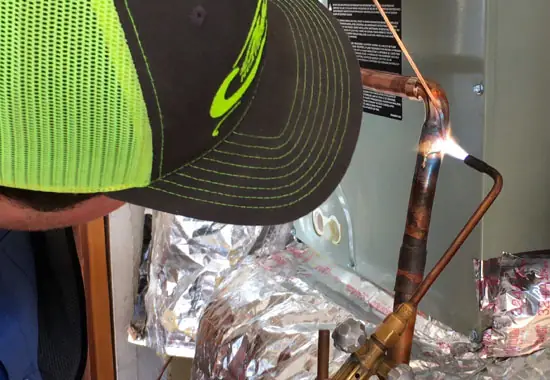
A torch brazing a copper line at an air handler, with the brim of a Chinook cap in the foreground

Saving energy

What the bill depends on.

Age, thermostat habits and the type of motor all move the number. The figures below are Chinook’s own claims, and they come with the company’s own caveat that savings vary from house to house.

If your furnace, air conditioner or heat pump is 10 or more years old, you are most likely paying too much every month on your energy bill. Chinook says recent innovations in heating and air conditioning units are saving homeowners an average of 50% per year on cooling with a 20 SEER air conditioning unit, and 33% per year with a 90 AFUE furnace. Ask about high-efficiency systems and how they can save you money on your gas and electrical bills.

Controlling energy costs starts with your thermostat. Chinook says you can save about three percent of your heating costs for every degree you lower your thermostat in the winter, and cut cooling costs by up to six percent for every degree you raise it in the summer. A programmable thermostat helps by letting you set different temperatures for different times of day, and a Wi-Fi programmable thermostat lets you adjust the setting from your phone, tablet or computer when you are not at home. Potential energy savings may vary depending on your personal lifestyle, system settings, equipment maintenance, local climate, actual construction and installation of equipment and duct system.

If you are shopping for a new heating and air conditioning system, consider a high-efficiency variable-speed system. Variable-speed means the system varies its speed depending on your home's heating and cooling requirements, so you get the amount of heating or cooling you need without wasting energy. Chinook says a variable-speed system can save hundreds of dollars every year because of its highly efficient operation.

Just like changing the oil in your car every 3,000 miles, a well-maintained heating and air conditioning system gives you peak performance and comfort for years. When a Chinook service technician checks your system on a regular schedule, you extend its life and keep it performing at its best. Ask about the 90 minute tune-up maintenance plan and the additional savings that come with being a member.

Think of your air conditioner and furnace as one total system. It works better, lasts longer and runs more efficiently when all of its components are matched in capacity and efficiency, and a mismatched system that mixes old technology with new could decrease performance and overall comfort. A new air conditioner is rated for a certain Seasonal Energy Efficiency Ratio (SEER), but SEER is determined by a complete system combination. If your furnace and indoor coil are older or do not match in efficiency and capacity, you might not get the efficiency level you paid for. An older indoor coil may also be dirty and clogged with particles, which means more energy is needed to push air through the system.

One of the first things Chinook does is a complete energy analysis of your home. That means measuring windows and checking insulation, ductwork and building materials, and reviewing a variety of other factors to determine the right size system and equipment. The technician also asks about your existing comfort challenges and makes recommendations. The quote for a high-efficiency new or replacement system is free.

Service and replacement

Keeping it running, and knowing when to swap it.

Regular service, matched equipment and a correctly sized system all come up in the answers here. For what a new system involves, see air conditioning installation.

Air quality and safety

What you breathe at home.

A tight, efficient house holds heat and also holds whatever is in the air. Two answers on that, one about particles and one about a gas you cannot see or smell.

We spend about 90 percent of our time every day indoors. Today's efficient, airtight homes are excellent at conserving energy, but that also makes them better at trapping potentially irritating particles inside the home. With the rising number of people who suffer from allergies and asthma, indoor air quality matters more and more to general health and well-being. Chinook says an air scrubber can eliminate 99.98% of allergens and other pollutants in the home, and the Air Scrubber Plus page covers the product.

Carbon monoxide is an invisible, odorless, tasteless gas produced when fossil fuels do not burn completely or are exposed to heat. Those fuels include wood, charcoal, oil, natural gas, gasoline, kerosene and propane. A carbon monoxide alarm monitors the air inside your home and sounds before carbon monoxide levels become a threat. Ask Chinook about installing an alarm in your home.

More answers

Two more question sets live with the services they belong to.

Duct cleaning

Price, dryer vents, equipment, how long the visit takes and how often to book it.

Duct cleaning questions

Maintenance plans

Scheduling a tune-up, automatic payment, cancelling, and whether you really need regular HVAC service.

Maintenance plan questions

Emergency service 24/7

Not answered here? Ask a technician.

Call the office and someone from the crew will talk it through with you. Emergency service runs 24/7, and the office is open Mon to Fri, 7 AM to 5 PM.